
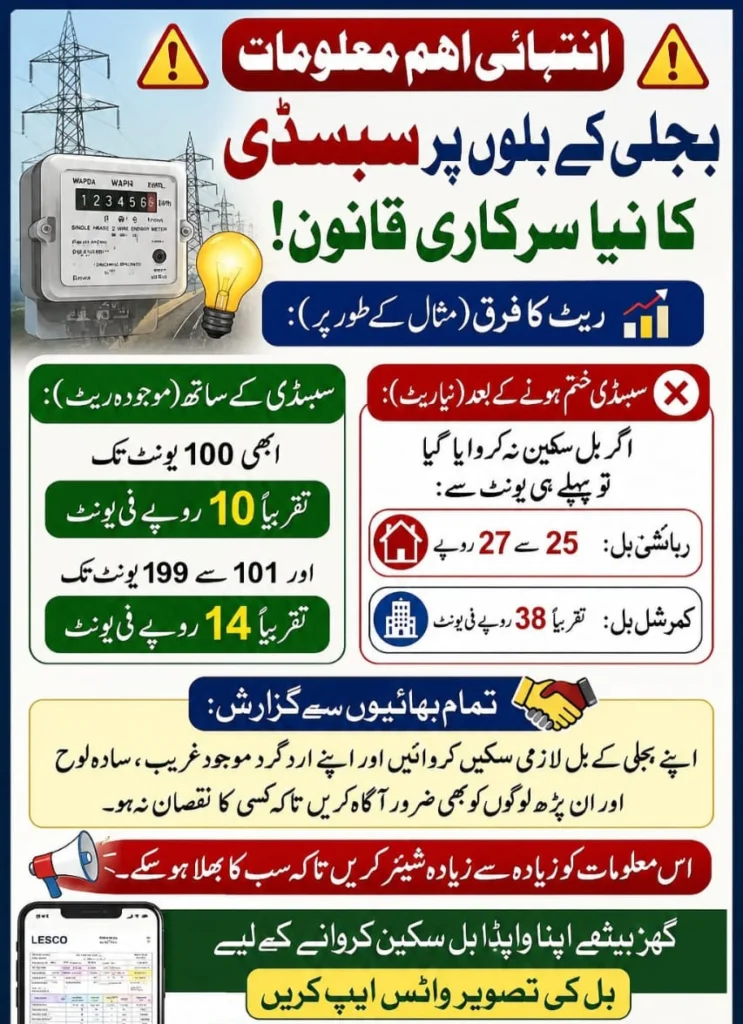

Pakistan electricity subsidy is live but unregistered homes pay Rs 22–29 per unit instead of Rs 10–13. Register free at css.pitc.com.pk in 2 minutes. Full rate table, calculator & step-by-step guide inside.
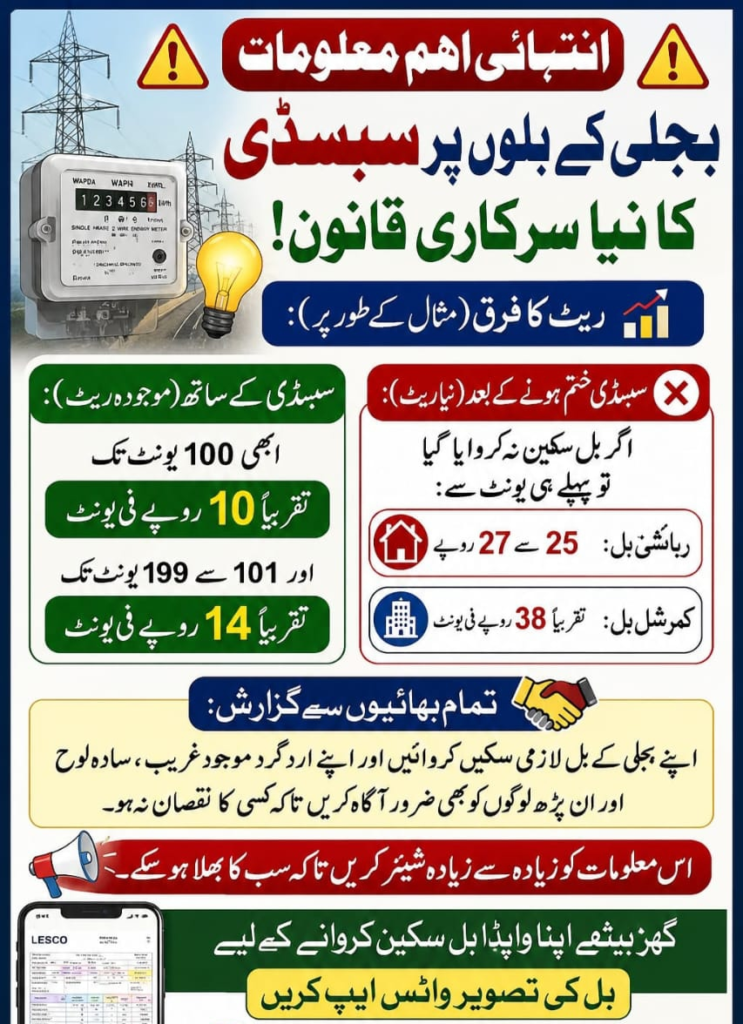
Table of Contents
Introdcuction
If you haven’t scanned your electricity bill and registered at css.pitc.com.pk, your protected tariff is not confirmed — regardless of how few units you use. This applies to all 11 WAPDA DISCOs across Pakistan.
If you haven’t scanned your electricity bill and registered at css.pitc.com.pk, your protected tariff is not confirmed — regardless of how few units you use. This applies to all 11 WAPDA DISCOs across Pakistan.
Millions of Pakistani households are sitting on a government subsidy they haven’t claimed — and a new federal directive now requires them to act before the protected tariff disappears from their bills entirely. The Power Information Technology Company (PITC), operating under the Ministry of Energy, launched its Cross Subsidy Program (CSS) in May 2026, making official bill registration mandatory for domestic consumers who want to keep paying roughly Rs 10 per unit instead of Rs 25 or more.
That gap is the whole story. Miss the registration, and your next bill won’t look like a billing error. It will be mathematically correct — just at the wrong rate.
➛ For More Updates Visit Apex News
The Rate Gap — What Protected vs Unprotected Actually Means
NEPRA’s tariff structure for fiscal year 2025–26 is confirmed unchanged. The difference between a registered protected consumer and an unregistered one is not a rounding error — it’s more than double the per-unit cost.
| Consumption Slab | Protected Registered | Unprotected Not Registered | Difference / Unit |
|---|---|---|---|
| 1 – 100 units / month | Rs 10.54 | Rs 22.44 | + Rs 11.90 |
| 101 – 200 units / month | Rs 13.01 | Rs 28.91 | + Rs 15.90 |
| 201 – 300 units / month | Not eligible | Rs 33.10 | — |
| Fixed charge (≤100 units) | Rs 200 / month | Rs 275 / month | + Rs 75 |
| Fixed charge (101–200 units) | Rs 300 / month | Rs 400 / month | + Rs 100 |
Source: NEPRA Uniform Tariff Notification, January 2026. Base rates only — FPA, QTA, taxes and NJHP surcharge apply on top.
Live Bill Calculator — See Your Exact Monthly Saving
Live Bill Calculator — See Your Exact Monthly Saving
Base unit cost + fixed charge only. Actual bill includes FPA, QTA & taxes (typically +30–40%)
Why the Government Built a Registration System for Electricity Subsidy
Pakistan's electricity tariff was always designed to protect low-consumption households. Families using under 200 units monthly were supposed to pay the lower protected rate. That part was never secret.
Higher-consuming and industrial consumers pay slightly more per unit so that low-consuming domestic households pay significantly less. The "cross" in cross-subsidy refers to this deliberate cost transfer — it's structural government policy, not a one-time relief payment.
The problem was enforcement. For years, protected tariff status was applied to any meter showing low usage — servant-quarter connections inside wealthy homes, vacant plot meters, commercial setups registered as residential. Genuine families were mixed in with accounts that clearly didn't need the relief.
PITC processes over 21 million consumer bills monthly across all major DISCOs. The CSS program fixes the targeting problem by linking each meter to a specific CNIC and verified mobile number. The government now confirms the protected tariff is reaching an actual household — not just a reference number floating in a billing database.
The "cross" in cross-subsidy refers to a deliberate cost transfer: higher-consuming and industrial consumers pay slightly more per unit so that low-consuming domestic households pay significantly less. It's structural government policy, not a one-time relief payment.
➛ FESCO Cross Subsidy Program Pakistan 2026
Who Qualifies for Electricity Subsidy?
| Criterion | Qualifies | Disqualifies |
|---|---|---|
| Connection type | Domestic residential only | Commercial, industrial, agricultural |
| Monthly usage | 200 units or fewer (6-month avg.) | Average above 200 units |
| Meter status | Single live connection at address | Multiple connections under one CNIC |
| CNIC | Valid Pakistani CNIC for verification | Expired or unverifiable CNIC |
| Mobile SIM | Registered in applicant's name | Unregistered or third-party SIM |
| Tenants | Occupant may register with own CNIC | Joint meters serving multiple units |
All 11 WAPDA DISCOs covered under this program:
Complete Registration Guide For Electricity Subsidy
Three things only: your 14-digit bill reference number (near the barcode on your paper bill), your 13-digit CNIC, and a Pakistani mobile SIM registered in your name for the OTP verification code.
-
1Open the official registration portalGo to css.pitc.com.pk in Chrome or Firefox. Clear your browser cache first if you've visited before. Keep only one tab open — multiple tabs cause session conflicts.Open css.pitc.com.pk Switch to mobile data if Wi-Fi is slow
-
2Find your 14-digit reference numberIt's printed near the barcode on your paper electricity bill. Also visible on the main screen of your DISCO's mobile app (LESCO, MEPCO, etc.). This number is unique to your meter — different from your CNIC.
-
3Scan the QR code — or enter manuallyPoint your camera at the QR code on the printed bill. If it doesn't scan (common with older printouts), type your 14-digit reference number into the input field manually.Manual entry works just as well as QR scan
-
4Enter your 13-digit CNIC numberType your CNIC exactly as printed — no dashes needed on most portals, but match the format shown on screen. Tenants may use their own CNIC even if the account is in the landlord's name.
-
5Enter your registered mobile numberUse a SIM that's biometrically verified and registered in your name. If your SIM isn't verified, visit any telco franchise first — the OTP will fail otherwise.Unverified SIMs cannot receive OTP codes
-
6Submit the OTP codeEnter the 4–6 digit code received via SMS within 3–5 minutes. Don't request OTP more than 3 times rapidly — the system temporarily locks your session after repeated failures.
-
7Receive confirmation — check your next billOnce verified, the protected tariff is applied from your very next billing cycle. You'll receive an SMS confirmation. Check the consumer category field on your next printed bill.The earlier you register, the sooner your bills drop
Call 118 — free, 24/7 from any Pakistani mobile or landline. Ask for your current consumer category status. Fastest way to confirm without navigating the portal again.
Portal Troubleshooting
| Problem | Fix |
|---|---|
| Portal loads slowly or times out | Try 11 PM – 5 AM — server traffic drops significantly after midnight |
| QR code scan fails | Enter 14-digit reference number manually in the input box |
| OTP not arriving | Check SIM is biometrically verified; switch off Wi-Fi; use mobile data; wait 5 min before retrying |
| Session error or page crash | Clear browser cache, close all other tabs, use Chrome or Firefox only |
| CNIC mismatch error | Double-check every digit — tenants may use their own CNIC even if account is in landlord's name |
| Reference number not found | Confirm your DISCO — K-Electric customers are not covered by PITC's CSS portal |
Scam Warning for Electricity Subsidy
Every time a government relief program trends, fake agents appear on WhatsApp claiming to offer fast-track registration or guaranteed approval for a fee. Nobody needs payment to register you. The entire process on css.pitc.com.pk is completely free and takes under two minutes. Ignore any such contact completely — report it to PTA if needed.
Summer Warning — AC Season Is the Main Trigger
Protected status is based on a 6-month rolling average. Cross 200 units even once and your entire next bill — including the first 100 units — shifts to unprotected rates. Monitor monthly via your DISCO's mobile app. Staying under 200 units for five out of six months keeps your rolling average safe.
The 200-Unit Trap — And How to Avoid It
Protected status is not permanent. NEPRA defines a protected consumer as a domestic user whose average monthly consumption over the past six consecutive billing cycles does not exceed 200 units. Cross that threshold even once — say, in July when air conditioners run all day — and your category shifts to non-protected for the following billing period.
Once reclassified, all units are billed at the higher unprotected rate. Including the first 100. A family that used 180 units from November through April and then 210 in one hot May can find their next bill calculated entirely at non-protected rates. The jump looks like a billing error. It isn't.
Air conditioner usage in June–August is the most common reason Pakistani households lose protected status. If you expect heavy summer usage, monitor your monthly units actively via your DISCO's mobile app. Staying under 200 units for five out of six months keeps your rolling average in the protected zone.
New Fixed Charges Added From February 2026
The per-unit rate is only one part of your bill. NEPRA approved new fixed monthly charges from February 2026 — applied regardless of how many units you consume. These add to the per-unit cost every single month, including months of zero consumption. Protected consumers pay Rs 200–300 per month in fixed charges. Unprotected consumers pay Rs 275–675 depending on their consumption slab.
Sources of Information
Billing disputes, classification checks, status confirmation
Self-submit readings, track monthly consumption
Conclusion for Electricity Subsidy
The government subsidy on electricity bills is real, the registration requirement is real, and the rate gap between those who register and those who don't is large enough to reshape any household budget this summer. Registration takes two minutes at css.pitc.com.pk and costs nothing.
The consequences of not registering — a bill that's often double the protected rate — will cost considerably more. Share the link plainly with anyone nearby who uses a simple domestic meter and wouldn't otherwise know. That's the whole point of the program.

1 thought on “Pakistan Electricity Subsidy 2026 Register at css.pitc.com.pk or Pay Rs 25+ Per Unit”